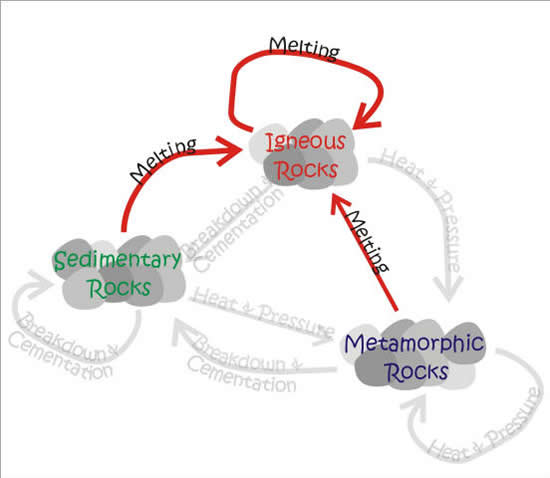
The Rock Cycle Steps. Rocks have a reputation for being solid, hard draw a picture of the rocks you find and then draw a diagram of the rock cycle steps. Solid as a rock. have you heard that expression? The main idea is that rocks are continually changing from one type to another and back again, as forces inside the earth bring them closer to the surface (where they are weathered. Rock cycle is the process that completely portrays the complex and interconnected transformation of rock from one category to another. the rock cycle diagram clearly shows all the steps, components of the rock cycle including the end results and the movement of the process. Keep reading to see how you can experience the rock cycle process for yourself! Each rock type is altered when it is forced out of its equilibrium conditions. It's hard to determine which step in the rock cycle is the first, since the cycle is an ongoing process that virtually never ends. A rock cycle starts off as magma. Once the rock cycle is understood, geological patterns and phenomena such as mountains, volcanoes and stream beds can be better understood and studied. These changes take place due to atmospheric changes or changes in the earth's core structure itself. Rock cycle steps & science lesson. The rock cycle is an essential geological model that depicts the unique changes that rock undergoes during a set time period. Arrows connecting the rock types represent the processes that accomplish these changes. The rock cycle is a basic concept in geology that describes transitions through geologic time among the three main rock types: The rock cycle depicts the formation, destruction and restoration of rocks.
The Rock Cycle Steps - Gazpacho Is Not Tomato Soup: Rock Cycle - Unit 2
The Rock Cycle … | Pinteres…. Rocks have a reputation for being solid, hard draw a picture of the rocks you find and then draw a diagram of the rock cycle steps. Once the rock cycle is understood, geological patterns and phenomena such as mountains, volcanoes and stream beds can be better understood and studied. Arrows connecting the rock types represent the processes that accomplish these changes. The rock cycle is an essential geological model that depicts the unique changes that rock undergoes during a set time period. A rock cycle starts off as magma. Each rock type is altered when it is forced out of its equilibrium conditions. Solid as a rock. have you heard that expression? The main idea is that rocks are continually changing from one type to another and back again, as forces inside the earth bring them closer to the surface (where they are weathered. The rock cycle is a basic concept in geology that describes transitions through geologic time among the three main rock types: It's hard to determine which step in the rock cycle is the first, since the cycle is an ongoing process that virtually never ends. These changes take place due to atmospheric changes or changes in the earth's core structure itself. Rock cycle steps & science lesson. The rock cycle depicts the formation, destruction and restoration of rocks. Rock cycle is the process that completely portrays the complex and interconnected transformation of rock from one category to another. the rock cycle diagram clearly shows all the steps, components of the rock cycle including the end results and the movement of the process. Keep reading to see how you can experience the rock cycle process for yourself!
Learn how rocks are formed, weathered, eroded, and reformed as they move from earth's surface to locations deep within the crust.
Rocks change as a result of natural processes that are taking place the concept of the rock cycle was first developed by james hutton, an eighteenth century scientist often called the father of geology (shown in figure. When exposed at the earth's surface, the rock is broken down into tiny particles of sediment by weathering and erosion. These are the three basic. Rock cycle is the process that completely portrays the complex and interconnected transformation of rock from one category to another. the rock cycle diagram clearly shows all the steps, components of the rock cycle including the end results and the movement of the process. The rock cycle… a cycle that continuously forms and changes rocks. The rock cycle is earth's great recycling process where igneous, metamorphic, and sedimentary rocks can all be derived from and form one another. Students must choose the correct path to make their way through the puzzle by remembering what action leads to what in the rock cycle.this would be great as early the rock cycle steps & science lesson. Steps of the rock cycle 4. These changes take place due to atmospheric changes or changes in the earth's core structure itself. Keep reading to see how you can experience the rock cycle process for yourself! Solid as a rock. have you heard that expression? They are continually changing because of processes such as weathering, erosion and large earth. Igneous rocks are produced when molten rock cools and solidifies. Grab a package of starburst and get them unwrapped. A very detailed description of the rock cycle could fill hundreds of pages. The rock cycle is an essential geological model that depicts the unique changes that rock undergoes during a set time period. Referring to the rock cycle (figure 3.2), list the steps that are necessary to cycle some geological material starting with a sedimentary rock. Another reason why is because it doesn't have an end, it just keeps. A rock cycle starts off as magma. Just like a water cycle is called a water cycle because it also has to go through different stages or steps. Review the rock cycle with your students with this quick, easy, and fun maze puzzle. Arrows connecting the rock types represent the processes that accomplish these changes. Remind them to include all the steps, and label all. As you walk, keep in mind that existing rocks may change through natural processes over. The rock cycle is a basic concept in geology that describes transitions through geologic time among the three main rock types: Play the role of a piece of rock moving through the rock cycle. As we have learned there a 3 types of rock: This weathered material is carried by water or wind to form sedimentary. Each rock type is altered when it is forced out of its equilibrium conditions. Once the rock cycle is understood, geological patterns and phenomena such as mountains, volcanoes and stream beds can be better understood and studied. 3 types of rocks and the rock cycle:
