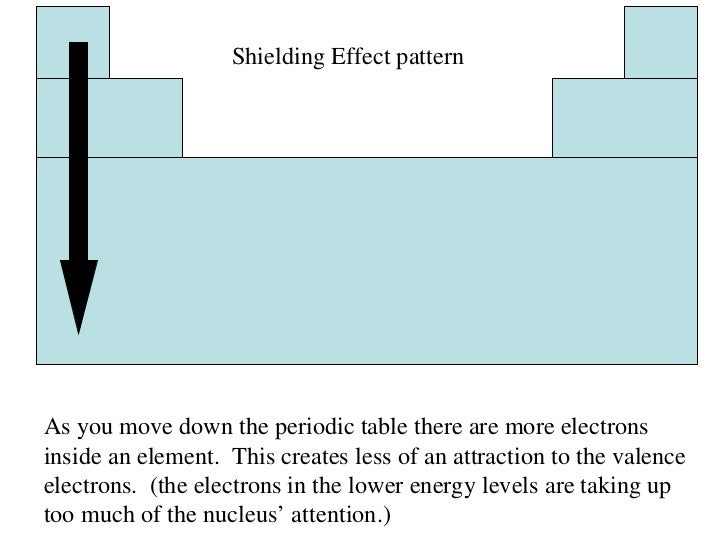
Shielding Effect Periodic Trend. Hence, there is a regular variation(a periodic trend). Periodic trends are specific patterns that are present in the periodic table that illustrate different aspects of a certain element, including its size and its electronic properties. Shielding effect is the decrease in the attractive force of the nucleus on tge valence electrons due to inner shell electrons. Across, the period, a row of the periodic table, from left to right as we face the table, atomic markedly. As we move in period the number of and what is the experimental consequence? Shielding effects of various element usually increases down the group. Shielding effect is caused by the shells(and the electrons in them) that are between the nucleus and the valence shells. Shielding effect can be defined as a reduction in the nuclear charge on the electron cloud, due to a difference in the attraction forces of the electrons on the nucleus. My chemistry teacher put it this way: The ionization energy of the elements within a period generally increases from left to right. You may also have heard. The shielding effect describes the attraction between an electron and the nucleus in any atom with more than one electron shell. Trend of shielding effect in periodic table. The shielding effect is basically the decrease in attraction between an electron and the nucleus due to electrons closer to the nucleus on earlier valence levels. A period on the periodic table groups together all elements that a particular number of shells, thereby, indicating the shielding effect!
Shielding Effect Periodic Trend - 8 Chemistry Trends Across The Periodic Table Explained
PPT - The Periodic Table PowerPoint Presentation, free download - ID:6840776. My chemistry teacher put it this way: Shielding effect can be defined as a reduction in the nuclear charge on the electron cloud, due to a difference in the attraction forces of the electrons on the nucleus. Across, the period, a row of the periodic table, from left to right as we face the table, atomic markedly. You may also have heard. Shielding effect is caused by the shells(and the electrons in them) that are between the nucleus and the valence shells. Shielding effect is the decrease in the attractive force of the nucleus on tge valence electrons due to inner shell electrons. Hence, there is a regular variation(a periodic trend). Trend of shielding effect in periodic table. As we move in period the number of and what is the experimental consequence? Shielding effects of various element usually increases down the group. The shielding effect is basically the decrease in attraction between an electron and the nucleus due to electrons closer to the nucleus on earlier valence levels. The ionization energy of the elements within a period generally increases from left to right. The shielding effect describes the attraction between an electron and the nucleus in any atom with more than one electron shell. A period on the periodic table groups together all elements that a particular number of shells, thereby, indicating the shielding effect! Periodic trends are specific patterns that are present in the periodic table that illustrate different aspects of a certain element, including its size and its electronic properties.
Periodic table from image.slidesharecdn.com
The ionization energy of the elements within a period generally increases from left to right. If you look at the periodic table, ionization energy tends to decrease as you move down a column and increase as you atoms and ions get bigger as you go down the columns because the shielding effect outweighs the. effective nuclear charge, zeff, experienced by an electron is less than the actual nuclear charge, z. As we move in period the number of and what is the experimental consequence? Weakens the attraction between electrons and the nucleus because of core electrons. This is the currently selected item. Shielding effect can be defined as a reduction in the nuclear charge on the electron cloud, due to a difference in the attraction forces of the electrons on the nucleus.
Nuclear charge (the number of protons in the nucleus), the electron shell(s), and the shielding (the effect of the electrons between the outer electrons and the nucleus).
The ionization energy of the elements within a period generally increases from left to right. Periodic trends affect bonding due to the arrangement of the elements on the periodic table. Learn about the chemistry topic periodic table trends in this free and fun science study guide! Periodic trends in ie, ea, e. These effects are summarized in table 1 below. The configurations of elements in the table provide specific periodic trends, one related to a strong shield effect will influence the ease in which electrons can be removed, which is known as ionization energy. In a group, while moving from top to bottom it decreases. Different types of chemical bonding, and patterns and trends can be observed in their this is because of the screening effect of the filled inner electron levels. Trend in atomic radius across a period. There are periodic trends of shielding effect. The strength of shield effects can be estimated using the periodic table. A period on the periodic table groups together all elements that a particular number of shells, thereby, indicating the shielding effect! These electrons screen or shield the outer electrons from the nuclear charge. Shielding effect is caused by the shells (and the electrons in them) that are between the nucleus and the valence shells. The electronegativity of atoms increases as you move from left to right across a period in the periodic table. More shielding = less ionization energy less shielding = more ionization energy (electrons held. Trends across a period follow from the increasing number of protons in the nucleus and the decrease in radius. Shielding effect can be defined as a reduction in the nuclear charge on the electron cloud, due to a difference in the attraction forces of the electrons on the nucleus. The shielding effect is basically the decrease in attraction between an electron and the nucleus due to electrons closer to the nucleus on earlier valence levels. If you look at the periodic table, ionization energy tends to decrease as you move down a column and increase as you atoms and ions get bigger as you go down the columns because the shielding effect outweighs the. The shielding effect describes the attraction between an electron and the nucleus in any atom with more than one electron shell. The second factor that decreases the ionization energy is the shielding effect due to an increasing number of shells as we move down a group. Periodic trends are evident when closely evaluating the periodic table based on a score of chemical/physical properties. Atomic radius tend to decrease (get smaller). The effect of the material is impressive: Shielding effect across a period atomic radius effective nuclear charge trend nuclear charge trend periodic table. Across, the period, a row of the periodic table, from left to right as we face the table, atomic markedly. As we move in period the number of and what is the experimental consequence? A period on the periodic table groups together all elements that a particular number of shells, thereby, indicating the shielding effect! Shielding effect is the decrease in the attractive force of the nucleus on tge valence electrons due to inner shell electrons. There are no shielding electrons, therefore the.
Shielding Effect Periodic Trend - You May Also Have Heard.
Shielding Effect Periodic Trend , What Is Atomic Radius In Chemistry - Slideshare
Shielding Effect Periodic Trend , Shielding Effect Trend In Periodic Table | Decoration Jacques Garcia
Shielding Effect Periodic Trend . The Shielding Effect Is Basically The Decrease In Attraction Between An Electron And The Nucleus Due To Electrons Closer To The Nucleus On Earlier Valence Levels.
Shielding Effect Periodic Trend , Nuclear Charge (The Number Of Protons In The Nucleus), The Electron Shell(S), And The Shielding (The Effect Of The Electrons Between The Outer Electrons And The Nucleus).
Shielding Effect Periodic Trend , Shielding Effect Across A Period Atomic Radius Effective Nuclear Charge Trend Nuclear Charge Trend Periodic Table.
Shielding Effect Periodic Trend - A Period On The Periodic Table Groups Together All Elements That A Particular Number Of Shells, Thereby, Indicating The Shielding Effect!
Shielding Effect Periodic Trend - How Much The Outer Electrons Are Repelled By Inner Electrons (Negative Repels Negative), And Also Describes How Much Increases Slightly Going Left On Periodic Table Because The Nucleus Loses Protons And The Atom Has The Same Number Of Energy Levels As You Move Across A Period.
Shielding Effect Periodic Trend - The Effect Of The Material Is Impressive:
Shielding Effect Periodic Trend : Shielding Effect Is Caused By The Shells (And The Electrons In Them) That Are Between The Nucleus And The Valence Shells.